
Gamification in Loyalty Programs: How to Engage Customers and Build Genuine Brand Loyalty

Executive Summary:
Gamification transforms traditional loyalty programs into engaging customer experiences. By combining game mechanics such as points, challenges, badges, and loyalty tiers with personalization, businesses can increase customer engagement, encourage repeat interactions, and strengthen long-term loyalty. This article explores the psychology behind gamification and shares practical strategies for designing loyalty programs that improve customer retention and deliver lasting business value.
Gamification in Loyalty Programs: How to Engage Customers and Build Genuine Brand Loyalty
In today's digital landscape, traditional loyalty programs based solely on collecting stamps or points are becoming increasingly less effective. Technological advancements have not only transformed the way brands communicate with customers but have also reshaped consumer expectations. Younger generations, in particular, having grown up surrounded by smartphones, mobile apps, and social media, expect far more from brands than simple transactions. They want to actively participate in brand interactions, engage with brand experiences, and derive enjoyment and satisfaction from them. Understanding these evolving customer behaviors and expectations has become one of the key factors in building long-term customer loyalty and achieving a sustainable competitive advantage.
Gamification has emerged as a powerful response to these changing expectations. By incorporating game-like elements into customer experiences, brands can transform routine interactions into more engaging and rewarding experiences. Its effectiveness lies in leveraging psychological mechanisms that strengthen motivation, create a sense of progress, and encourage ongoing interactions with the brand.
What Is Gamification?
At its core, gamification involves applying game design elements – such as challenges, achievement, transparent rules, and engaging experiences – to non-game contexts in order to increase user motivation and encourage specific behaviors. From a business perspective, gamification can be understood as the integration of game mechanics into products and services to increase customer engagement and strengthen brand attachment (Hwang & Choi, 2020).
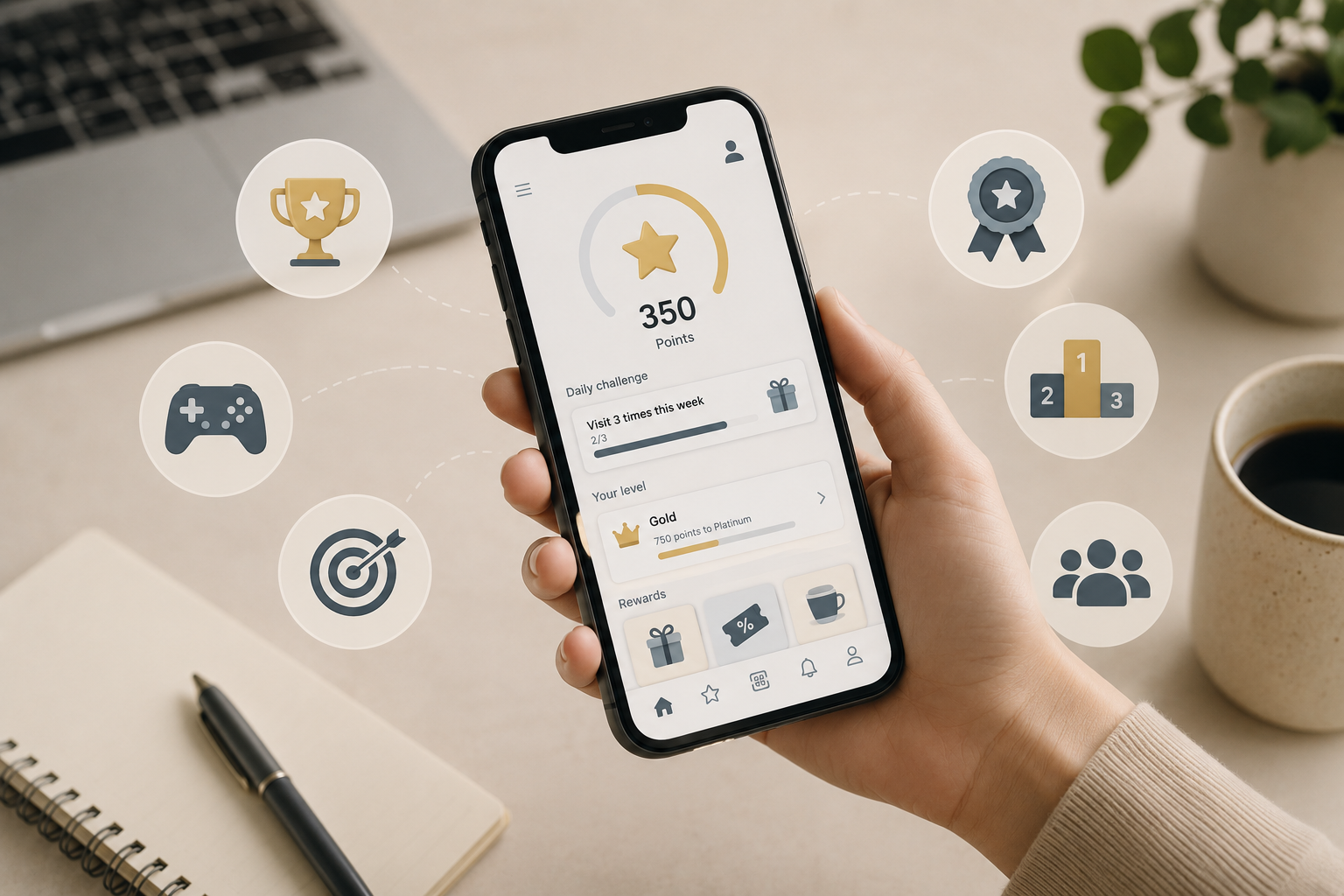
Some of the most widely used gamification mechanics include points, badges, levels, leaderboards, challenges, missions, and rewards granted for completing specific actions. These elements encourage users to interact more frequently, reinforce a sense of progress, and make the overall experience more enjoyable and satisfying. It is therefore not surprising that both businesses and researchers increasingly recognize the potential of gamification as an effective tool for enhancing customer engagement, improving customer retention, and building stronger brand loyalty.
Gamification in Loyalty Programs
One of the areas where gamification mechanisms have found particularly broad application is loyalty programs. By integrating game elements, traditional point collection or stamp-based programs can be enhanced with challenges, missions, loyalty tiers, and rewards that encourage deeper customer engagement and motivate users to interact with brands more frequently.
A well-known example of gamification in loyalty programs is the Starbucks mobile app. The company introduced a bingo-style game in which customers completed specific tasks, such as purchasing a particular beverage, visiting a store at a certain time of day, or taking advantage of selected offers. In return, users earned additional points that could later be redeemed for free drinks and other rewards. As a result, collecting points became more than a purely transactional process. Instead, it evolved into an engaging experience that encouraged customers to visit more often, explore new products, and interact with the brand on a regular basis.
Why Does Gamification Engage Customers?
The effectiveness of gamification goes far beyond simply making experiences more entertaining. Its impact is rooted in psychological mechanisms that strengthen user motivation and make brand interactions more engaging and rewarding.
The effects of gamification can be viewed from two complementary perspectives: emotional (hedonic) and practical (utilitarian). From a hedonic perspective, game mechanics provide users with enjoyment, a sense of achievement, and satisfaction from completing challenges and reaching milestones. As a result, even routine activities – such as making purchases or collecting loyalty points – become more enjoyable and engaging experiences.
From a utilitarian perspective, gamification increases the practical value of loyalty programs by helping customers achieve specific goals and gain tangible benefits from their actions. Clearly defined tasks, visible progress tracking, and reward systems enhance users' sense of control and effectively motivate them to remain active. A particularly important role is played by the feeling of progress. Visible advancement, reaching new levels, and unlocking rewards provide users with a sense of accomplishment and encourage them to continue interacting with the brand. This sense of progression transforms ordinary customer activities into meaningful experiences, increasing both engagement and long-term loyalty.
Personalization as the Key to Customer Engagement
Today's consumers often participate in multiple loyalty programs simultaneously, yet they actively engage with only a few of them. As a result, personalization has become increasingly important, with customers expecting offers, rewards, and communication tailored to their individual needs and preferences. The more closely a loyalty program aligns with a customer's expectations, the more likely they are to perceive interactions with the brand as meaningful and engaging.
Gamification can significantly support this process. Interactive challenges, quizzes, missions, and tasks encourage users to actively participate while simultaneously motivating them to voluntarily share information about their interests, shopping preferences, and motivations. As a result, brands can collect so-called zero-party data – information that customers intentionally and proactively provide. This type of data offers valuable insights into customer needs and preferences, enabling companies to create more relevant and personalized experiences.
By leveraging these insights, loyalty programs can move beyond a one-size-fits-all rewards model and deliver personalized challenges, product recommendations, and rewards tailored to individual users. Such an approach not only increases customer engagement but also strengthens long-term loyalty and reduces customer churn. In an increasingly competitive landscape, the ability to combine gamification with personalization is becoming a key differentiator for brands seeking to build deeper and more meaningful customer relationships.
How to Design Effective Gamification Solutions?
Successful gamification is about much more than simply adding points, badges, or leaderboards to a loyalty program. Its effectiveness largely depends on how the overall customer experience is designed and on the quality of interactions between the brand and its customers.
Research suggests that gamification initiatives are most effective when they combine a high level of interactivity with an optimal level of challenge. Interactive mechanics such as missions, quizzes, and challenges encourage active participation, reinforce a sense of progress, and help build stronger emotional connections between customers and brands. However, maintaining the right balance is essential. Tasks should be neither too easy nor overly complicated.
At the same time, not every gamification initiative leads to higher engagement. Studies show that gamified experiences can produce the opposite effect if users perceive them as mandatory or imposed. When participation is not voluntary, customers may experience a loss of autonomy, which can weaken brand attachment and reduce engagement. For this reason, users should always be free to decide whether they want to participate, which challenges they want to complete, and whether they wish to leave the experience at any point. Giving customers control over their participation strengthens their sense of autonomy and significantly increases the likelihood of a positive experience.
Context also plays an important role in the effectiveness of gamification. Its impact may be limited when customers are under time pressure. In such situations, additional tasks or challenges may be perceived as obstacles that interfere with the customer's primary goal rather than as engaging enhancements to the experience.
For example, customers rushing to work in the morning and simply looking to grab a quick coffee are unlikely to engage with additional in-app challenges. In contrast, during the evening or over the weekend, when users have more time and are browsing the app more casually, they may be far more willing to complete quizzes, collect badges, or take on extra challenges in exchange for rewards. Therefore, brands should promote gamified interactions primarily at moments when customers have greater flexibility and are more open to exploring additional activities and experiences.
Effective gamification should be tailored to the target audience.
Different mechanics appeal to different customer segments. Younger users may be more motivated by competition, achievements, and challenges, while other customers may value convenience and tangible benefits above all else. When designing gamified loyalty experiences, brands should therefore carefully consider users' motivations, preferences, and the context in which they interact with the loyalty program.
Finally, it is important to remember that gamification must deliver real value to users. Simply earning another badge or completing another challenge is rarely enough to sustain long-term participation in a loyalty program. Tangible benefits – such as attractive rewards, discounts, exclusive offers, early access to products, or personalized perks – play a crucial role in maintaining engagement. The most effective gamification strategies combine elements of fun with meaningful customer benefits. It is this combination of enjoyable experiences and real value that encourages customers to engage more frequently with a brand and remain loyal over the long term.
Conclusion
At a time when consumers participate in multiple loyalty programs simultaneously, simply offering points, discounts, or occasional promotions is no longer enough. What truly matters is creating experiences that engage customers, evoke positive emotions, and foster lasting relationships with the brand.
Gamification enables companies to transform traditional loyalty programs from purely transactional tools into engaging experiences built around interaction, a sense of progress, and achievement. Well-designed gamification mechanics not only increase the frequency of customer interactions with a brand but also generate valuable insights that make it possible to deliver increasingly personalized experiences.
However, the successful implementation of gamification depends on carefully designing the entire customer experience. This includes providing the right level of challenge, ensuring voluntary participation, considering the context in which customers engage with the program, and delivering real value to users. Gamification should not be viewed as an end in itself, but rather as a tool for enriching the customer experience and making participation in a loyalty program more meaningful and rewarding. Brands that successfully combine elements of fun with genuine customer benefits have a unique opportunity to build deeper relationships, increase customer engagement, and differentiate themselves more effectively in an increasingly competitive marketplace.
References:
- Berger, Axel & Schlager, Tobias & Sprott, David & Herrmann, Andreas. (2017). Gamified interactions: whether, when, and how games facilitate self–brand connections. Journal of the Academy of Marketing Science. 46. 1-22. 10.1007/s11747-017-0530-0.
- Hwang J, Choi L. Having fun while receiving rewards?: Exploration of gamification in loyalty programs for consumer loyalty. J Bus Res. 2020;106:365-376. doi:10.1016/j.jbusres.2019.01.031
- Shahid, Anam & Arshad, Sadia. (2021). Gamification and Consumer Loyalty: The Role of Utilitarian and Hedonic Benefit. Lahore Journal of Business. 10. 29-56. 10.35536/ljb.2021.i1.v10.a2.
Table of Contents
Read more articles

7 Loyalty Program Examples for Small Businesses
Summary: Explore seven simple loyalty program examples for cafes, salons and local shops. Choose a reward and rules that give customers a clear reason to come back. A loyalty program does not need a complex app or several reward levels. For a...

Vouchers as Rewards for Loyal Customers: How to Use Them
Summary: Learn how to use vouchers to reward returning customers. Explore three practical ideas, set clear terms and track whether customers redeem them and come back. A voucher can reward a repeat purchase, introduce a customer to a new service...

How to Start a Restaurant Loyalty Program
Summary: Plan a restaurant loyalty program with clear rules and a reward that fits your margins. Learn how to explain it at checkout and measure whether guests return. A returning guest already knows your menu and service. A loyalty program can...